


Corporate Event Management Day-Of Coordination Checklist for MENA Planners
Planning decides the agenda. Day-of coordination holds the room. This guide covers what on-ground management actually owns - an hour-by-hour timeline from load-in to teardown, the run-of-show and cue-sheet standard, vendor coordination in Egypt and the Gulf, and how to hire a team that can call the day so your own staff attend the event instead of running it.
What day-of coordination covers in a corporate event

Day-of coordination is live ownership of the event day, not an extension of planning. Planning decides the agenda, contracts, floor plan, and supplier scope. On-ground management takes over from load-in and holds the room: vendor briefing, registration and arrivals, AV and technical checks, VIP and protocol movement, timing control against the run-of-show, issue escalation, and teardown with a documented closeout.
The expected outcome is a single accountable team calling the day, so your own staff attend the event instead of running it.
Assemble six inputs before handover:
For corporate, government, and NGO functions across Egypt and the Gulf, that list carries extra weight: bilingual signage and announcements, donor or ministry guests with fixed arrival protocol, and controlled access zones all fail publicly when nobody owns them.
Build the day-of coordination checklist before load-in
Write the checklist while contracts are still open, not the night before. Every line should name one deliverable, one owner, and one time.
Cover these at minimum: venue access and dock permissions, the loading schedule by vendor, room setup and seating plan, registration desk and badge stock, wayfinding and stage signage, AV and technical checks, catering timings against the agenda, the speaker holding area, and the teardown plan with a load-out order.
Then assign ownership item by item. The venue team typically owns access, power, and fire compliance. Vendors own their own load-in, testing, and crew. The planner or lead coordinator owns the master timeline, registration flow, VIP movement, and the escalation path. Where two parties could claim an item - signage placement is the usual one - write the name of the person, not the company.
| Model | Control on the day | Setup speed | Accountability |
|---|---|---|---|
| In-house team | High on content and internal politics; thinner on vendor discipline | Fast for small internal meetings | Sits with staff already carrying other duties |
| Single production vendor | Strong within that vendor's own scope | Quick to brief | Clear for AV or catering, gapped between scopes |
| Full-service on-ground management | Single command structure across all vendors | Slower to onboard, faster once briefed | One named lead answerable end to end |
The honest tradeoff: internal teams know the organization, the stakeholders, and the sensitivities better than any external partner will. What they usually lack is a rehearsed on-site command structure and contractual pull over vendors mid-crisis.
Expected outcome: a one-page document that any crew member can read in thirty seconds and know what happens next.
The hour-by-hour timeline from load-in to teardown

Build the day as a clock, not a task list. Anchor every activity to doors-open time, then work backwards so each vendor knows the hour they own the room. A workable sequence for a half-day conference at a hotel or convention venue:
- T-6:00 - Load-in. Confirm dock access, freight lift booking, and venue security clearance for crew names and vehicle plates. Check each vendor's insurance certificate and equipment manifest against what security is expecting at the gate, since mismatched paperwork is the single most common cause of a delayed load-in. Assign a staging area for flight cases so the loading dock does not become a bottleneck for the next vendor in the queue.
- T-5:00 - Vendor check-in. Sign in each supplier against the arrival window, issue crew badges, and hand over the room plan. Assign radio channels so AV, security, and the floor manager are on separate frequencies from front-of-house. Walk each crew lead through venue house rules - smoking areas, break rooms, cabling routes that cannot cross fire exits - before they touch equipment.
- T-4:00 - Room setup. Verify seating counts, stage position, signage, and interpretation booths against the approved floor plan. Check sightlines from the back row, confirm branding matches the approved artwork exactly (logos, colors, Arabic and English copy), and test cable runs to the interpretation booths before power is live throughout the room.
- T-2:30 - Technical rehearsal. Test microphones, projection, recording, and the presentation laptop with the actual deck; run speaker walk-ons and cue confirmations with the show caller. Mic-check every speaker individually, including a lapel and handheld backup, confirm the recording device and any live-stream encoder are capturing clean audio, and lock the final slide deck version so nobody edits it after the rehearsal.
- T-1:30 - Registration opens. Position desk staff, test badge printing and the delegate registration list, and stage a separate lane for VIP and protocol arrivals. Set a staffing ratio that can absorb a bunching crowd, keep a printed backup list next to every laptop in case connectivity drops, and confirm bilingual signage directs guests to the correct lane without needing to ask.
- T-0:30 - Guest arrival. Ushers in place, hospitality flowing, holding room staffed. Confirm valet or parking flow is not backing up toward the main entrance, and check that security screening throughput matches the arrival rate so the queue does not spill into public view.
- T-0 - Program start, followed by controlled speaker changes, break service, close, and teardown against the venue's contracted out-time. During breaks, catering resets stations while AV pre-loads the next segment's media; VIP movement between sessions should use a route that does not cross general delegate traffic. Begin teardown of non-visible areas - back-of-house catering, unused breakout rooms - while the closing remarks are still running, so the visible teardown after doors-close is faster.
Timing control shifts by format. Forums with government and donor guests absorb time at arrivals and protocol seating, so pad the front. Product launches concentrate risk in the technical rehearsal. Internal meetings usually break down at catering timing and overrunning discussion.
Delays cluster in three places: late load-in access, presentation files arriving at the last minute, and VIP convoys landing off-schedule. A coordinator absorbs these by compressing breaks or holding the room - never by cutting a speaker mid-session.
Sara EventsThe run-of-show and cue-sheet standard
Build two documents before rehearsal day, and treat them as the only versions anyone works from.
The run-of-show is the master sequence for the whole event: every segment from doors open to final teardown, in order, with a named owner per line. The cue sheet is narrower and faster - it is the live instruction set the stage manager, AV lead, and sound operator read from, listing the exact trigger for each lighting change, video roll, microphone handoff, and walk-on.
Keep the field set minimal so it survives a live room. Each line needs five columns: time, owner, cue or action, backup action if it fails, and the approval contact authorized to change it mid-program. A line with no owner is an unassigned risk; a line with no backup is a stall waiting to happen.
Then connect the sequence outward. Registration open and peak arrival windows should sit on the same timeline as speaker call times, VIP arrival and escort routes, protocol seating, and media access windows - so a photographer is not walking a stage front during a minister's remarks.
Bilingual and multi-stakeholder programs in Egypt and the Gulf demand tighter discipline: interpretation channels, Arabic and English slide versions, and title accuracy all break silently if the document lags.
Expected outcome: a single approved run-of-show and cue sheet, reissued within minutes whenever a speaker, session length, or protocol requirement changes - with the old version pulled from circulation.
Vendor coordination: briefing, arrival windows, and escalation paths

Run one consolidated vendor briefing before event day - not separate calls with each supplier. Bring AV, catering, decor, security, transport, and registration into the same session, walk the run-of-show cue by cue, and confirm who does what at each transition. Every vendor should leave holding the same timeline document and the same contact list.
Confirm arrival windows in writing. Each vendor needs a stated load-in slot, a loading dock or service entrance, a vehicle access route, and a badge count submitted to venue security in advance. In Egypt and much of MENA, hotel and convention venues often require names and ID numbers for access passes a day or more ahead, and government or diplomatic venues add clearance layers. A verbal agreement will not get a truck through a gate.
Permits and paperwork carry real weight in this region. Imported or specialist AV equipment can require customs documentation, staging and rigging often need a civil defense or municipality certificate before rig-up is allowed, and outdoor signage or branding may need separate municipal approval. Build permit lead times into the production schedule, not into event week - a missing certificate at the gate stops load-in regardless of how good the crew is.
Bilingual crew discipline matters as much as bilingual guest-facing material. When instructions run in both Arabic and English, write the briefing pack in both languages and confirm each crew lead - not just the account manager - understands the cues in the language they work in. A cue sheet that only exists in one language is a risk on a mixed crew.
Government and diplomatic venues add their own access layer. Expect guest list submission deadlines well ahead of the event, security sweeps that lock the room for a fixed window before doors, restricted zones around VIP entry and exit routes, and dress or conduct requirements for crew working near official delegations. Confirm these requirements with the venue in writing, and brief every vendor on them - a supplier who shows up without the right clearance can be turned away at the door regardless of the contract.
Name one point of contact per vendor and one authorized decision-maker on the planning side. Conflicting instructions are the most common cause of delay on a multi-vendor floor: the AV lead hears one thing from the client's marketing manager and another from the venue coordinator. Route all changes through the single contact, and give that person spending authority within an agreed limit.
Write escalation paths before you need them. Define a named first responder and a fallback for each failure mode - late vendor arrival, missing equipment, speaker substitution or drop-out, projection or audio fault, and catering delay. Attach response times and phone numbers, not job titles alone.
What to look for when hiring day-of coordination
Interview providers against operational capability, not brochure language. Ask six things: who holds live command on site, who owns registration and arrivals, who supervises AV and technical management, how protocol movement is handled for ministers or donor delegations, whether briefings run in both Arabic and English, and what the closeout report contains. Insist on a sample run-of-show and cue sheet from a comparable function - redacted is fine.
Red flags that should rule a provider out:
Any one of these is worth a follow-up question. Two or more, and the provider is not ready for a multi-vendor corporate function.
Ask for proof by format, not volume. Request two references from conferences, forums, or institutional events in Egypt or the wider MENA region - one corporate, one government or NGO - and ask what went wrong on the day and how it was resolved.
Match depth to risk. A single-day internal meeting for 40 people rarely justifies a full production crew; a solo coordinator with a clear checklist can be sufficient and cheaper. Multi-vendor conferences with VIP protocol, hybrid streaming, and delegate registration need a command structure.
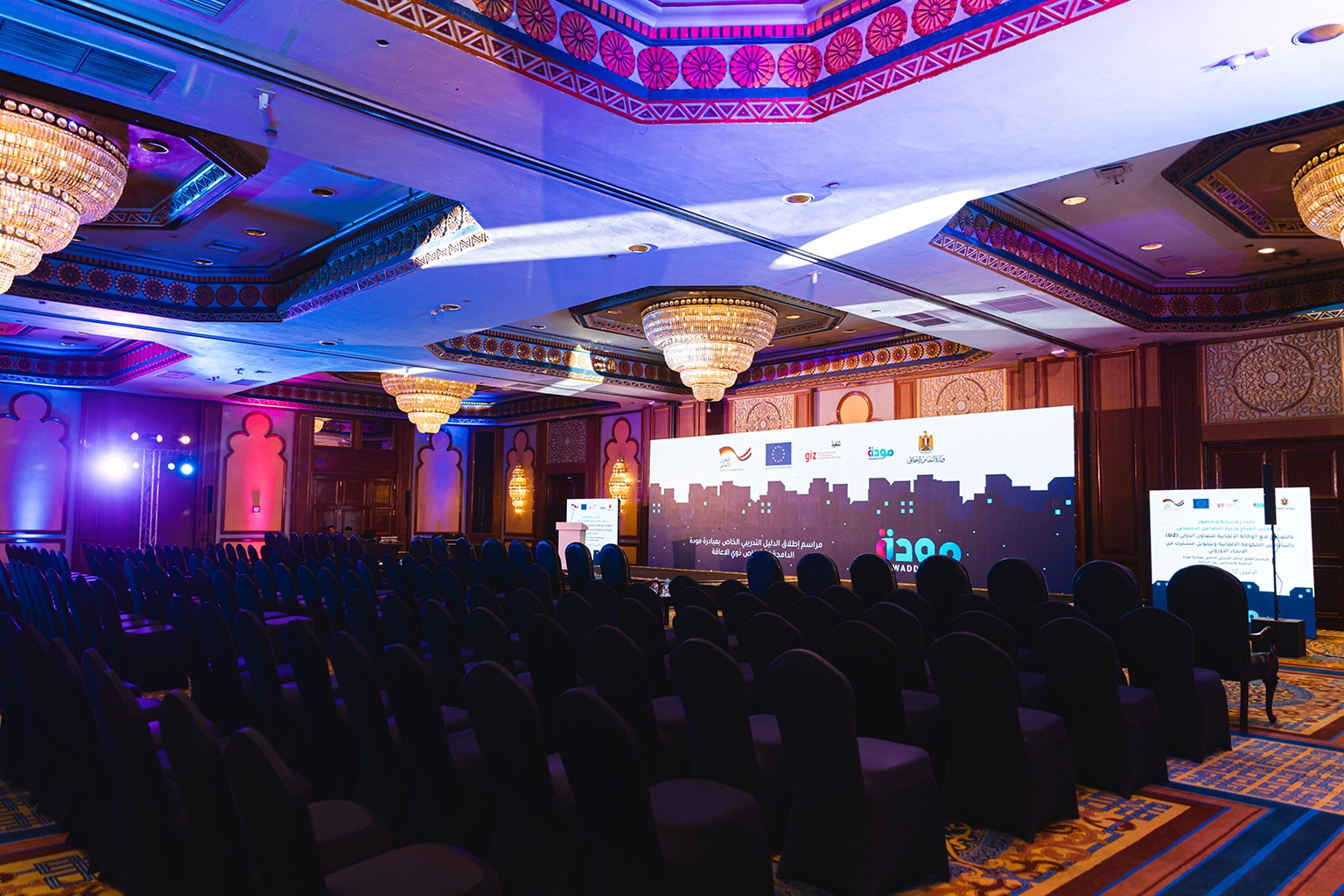
Sara Events delivers this scope as corporate event management with on-ground execution across Egypt, KSA, and the UAE: event production and technical management, delegate registration and check-in, catering coordination, VIP and protocol handling, and a written closeout after the event. The recap below shows that delivery model on site.
Frequently asked questions
Who owns the day-of checklist?
The lead coordinator owns the master document and is the single point of accountability if something falls through the gaps. Department leads - registration, technical, catering, protocol - own their own sections in detail and report status against that same document at agreed check-in times, rather than keeping separate lists that drift out of sync.
When should registration open?
Open early enough to absorb bunching at the door - typically well before the first session starts, and earlier still for events with VIP, donor, or government guests who arrive in a tight window together. Staff the desk to the expected arrival curve, not the average, keep bilingual signage and printed backup lists at every station in case connectivity drops, and run a separate lane for VIP and protocol arrivals.
Who is responsible for audiovisual failures?
The technical manager, working from the cue sheet, owns AV failure response end to end. That means a rehearsed fallback for each critical moment - the opening, the keynote, and any live link to remote speakers - plus backup hardware (a second microphone, a spare laptop with the deck loaded, a redundant recording device) staged and tested before doors open, not sourced after something fails.
How should vendors be briefed?
In writing before the day - arrival window, access route, badge requirements, and their section of the run-of-show - then again verbally at a consolidated on-site briefing that walks the whole cue sheet with every supplier in the room together. Use arrival windows rather than a single call time, since a shared call time creates a queue at the gate instead of a staggered, controlled load-in.
What actually changes on event day?
Planning stops and control begins. Decisions move from committee discussion to one coordinator working the clock, authorized to reroute timing, reassign staff, or invoke a backup plan without waiting for sign-off from a group that is no longer in the room.
Key takeaways for event day
Reread the sequence in order: load-in and venue handover, vendor arrival windows, technical checks and rehearsal, registration opening, doors, session-by-session cue calling, catering transitions, VIP and protocol movement, closing remarks, guest departure, teardown, and a written closeout. Every hour of the day should have a named owner, and nothing should depend on someone remembering it.
The tradeoff is straightforward: basic day-of coordination keeps the schedule moving, while full-service on-ground management also carries production, logistics, registration and ticketing, and protocol - at a higher cost and with earlier involvement required. For MENA formats across Egypt, Saudi Arabia, and the UAE, send your brief through the form below.
Request a Tailored ProposalNeed day-of coordination?
Share your event basics and Sara Events will scope the right on-ground approach - vendor coordination, registration, AV and technical management, protocol, and teardown included.
- Response within 24 hours
- Dedicated account manager
- Free initial consultation